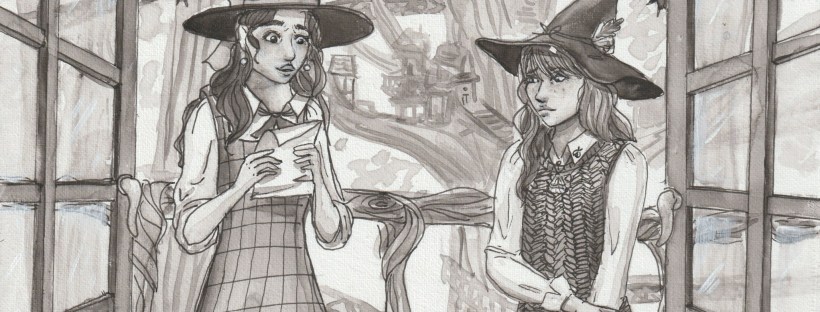
A Letter, a Lighthouse, and a Ghost Cat is finally out in the world! You can now order it for yourself, or ask your local library to stock a copy!
(For those of you who want to see it in your library, you can tell them they can order the book from “Ingram” which is the company that distributes my books.)

What to say about this ghostly little book…
It was written, as most of my books are, out of necessity. That is to say, not just because I wanted to, but because I had to. Because the idea haunted me (every pun intended) and would not rest until I had put it to paper.
Ultimately, it is a story about friendship. But not, alas, one of purely happy endings. Sometimes friendship is magic, but sometimes friendship is hard. Sometimes it is confusing. Sometimes it breaks your heart and haunts the shattered pieces.
No one talks about that part.

Most of the songs about heartbreak are of the romantic sort. The relationships at the center of most fiction are also “eros” as C. S. Lewis refers to romantic attachment in his book The Four Loves.
We have structure, and social and cultural expectations for how eros should progress. Everyone expects romantic relationships to be difficult, to break your heart, to require intentional work. They say that communication is key.
There are very few social and cultural expectations for how friendships should progress. And yet friendship is a human relationship like any other. One that can be difficult, can cause heartbreak, can require intentional work. Communication is still key.
Friendship struggles and falling outs happen far more often than our art and our culture acknowledges. So does loneliness and the longing for a close friend, one who you can love as your own soul.
When we hear the word “soulmates” we think of romance, yet one of the closest allusions to such a concept in Scripture is one of friendship:
“The soul of Jonathan was knit to the soul of David, and Jonathan loved him as his own soul.” — 1 Samuel 18:1

And then such a thing ends, sometimes with finality, but more often not. More often it is a painfully slow fade to black. A clinging to hope. A refusal to acknowledge that things are Different now. And suddenly the realization creeps along that maybe you’re not best friends anymore and what does one even begin to do with that?
The horrible thought arises: “Were we ever friends at all? Or was I the only one who really cared?”
I’m just a line in your book
You’re all the pages in mine
Why does it seem to happen like that every time?
I’m just a line
I’m just a line
— Gone by Morning, Madilyn Mei
This is the place that Ally Litchen finds herself in the beginning of A Letter, a Lighthouse, and a Ghost Cat. In a lighthouse, where waves crash against the shore, and memories she won’t let in crash against her mind.

I think there’s many reasons we don’t talk about platonic heartbreak. Part of it is purely realistic—is usually better not to burn bridges. If you leave the door open, there’s always a chance that friend will come back into your life later on. We want to forgive, most of the time. If you recount the sordid details to anyone, if you talk about how much the leaving hurt, especially within something public like art, there’s always a chance that past friend will hear of it. That is when things get Complicated.
The other part of the reason for this lack is that we simply do not know what to say. We have the vocabulary for romantic breakups, but how do we express this quiet, painful decay of a bond we had no reason to doubt, until we did? It is no easy thing, to live a life of empty doorways, propping them open just in case someone finds their way back in. It is difficult to sit in the emptiness, unsure if you want renewal or closure. Unsure if you’re the only one to hurt like this.
You’re not. I can tell you that much. So many young readers have already told me that just the concept of this book, of a story about friendship break-ups, resonates with them. You are not alone.

I can also tell you that you will not remain this way forever, although it may seem so at the time. For though you may journey through your own Tanglewood, though you may be haunted by your own ghosts, the path goes on. And perhaps there are sunflowers over the ridge. And perhaps there is cranberry bread in your pocket.

I feel I should set reader expectations that Ally’s broken friendship does not get mended in this book. Or, at least, they don’t go back to being the best of friends as they did before. This does not, in any way, mean that the ending of this book will be depressing, or that the message is not hopeful. There is hope outside of reconciliation. Sometimes, as we grow up, we have to realize that things can’t go back to the way they were, but that doesn’t mean that there aren’t beautiful things ahead as well.
If you are struggling with a friendship in your own life, I hope things do mend—in many cases they do! Ally’s story is, by no means, everyone’s. But whatever the outcome in your own life, I pray that A Letter, a Lighthouse, and a Ghost Cat will give you the courage and hope to believe that your future is bright and beautiful, whether it contains the people you expected, or not.
Docendo disco, scribendo cogito.
(I learn by teaching, think by writing.)
— Millie Florence
Follow the Blog
Receive an email whenever I post something new.
Thank you!
You'll hear from me next time I post.
*salutes* I will make sure all my friends read it and recommend it to every person I meet! (which I already do, but I have to make a new commitment for each book you publish)
*salutes back* your efforts are very much appreciated! XD